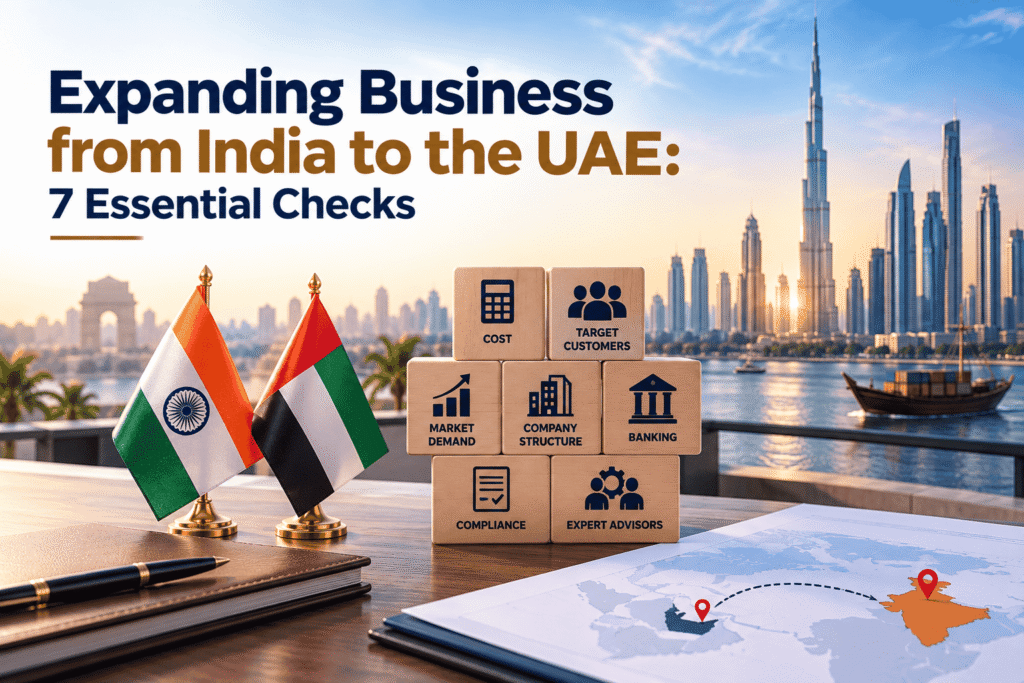
Setting up a Wholly Owned Subsidiary (WOS) in Dubai has become one of the most popular routes for Indian companies looking to expand into the UAE and wider GCC market. With 100% foreign ownership now permitted across most mainland activities and a well-established free zone system, Dubai offers Indian promoters a straightforward path to owning their overseas entity outright. However, before you remit a single rupee abroad, your company must comply with the Foreign Exchange Management Act (FEMA) and the Reserve Bank of India’s Overseas Investment framework.
This guide explains what a WOS is, why Indian businesses are choosing Dubai, the FEMA rules that govern the investment, and the exact steps to incorporate your subsidiary correctly the first time, including a practical step that many guides overlook: the DED does not license a foreign company as a 100% corporate shareholder from day one, so the shareholding is transferred into the Indian parent’s name only after incorporation.
What Is a Wholly Owned Subsidiary (WOS) in Dubai?
A Wholly Owned Subsidiary is a foreign entity in which an Indian company holds 100% of the equity capital, giving it complete ownership and control without a local or foreign partner. This differs from a Joint Venture (JV), where the Indian company holds a stake alongside another shareholder.
In the UAE context, a WOS can be registered as:
- A mainland Limited Liability Company (LLC) under the Department of Economy and Tourism (DET)
- A free zone company under any of the UAE’s free zone authorities
- A branch office of the Indian parent company, where permitted
A practical point on mainland incorporation**: on the Dubai mainland, the DED’s licensing system is built around a natural person as the applicant and initial shareholder. In practice, this means the company is first incorporated with an individual, typically the promoter or a nominated manager, as the sole shareholder, who then obtains the manager or investor visa. Once the entity is licensed and operational, the shares are transferred to the Indian parent company, converting it into a true corporate WOS. This share transfer involves money changing hands and must be separately checked against FEMA, since it is treated as a distinct overseas investment event in its own right.
Why Indian Companies Are Setting Up a WOS in Dubai
- 100% ownership: Since the 2021 reforms to the UAE Commercial Companies Law, most mainland activities no longer require a UAE national partner, so an Indian parent can hold the entire share capital
- Favourable tax regime: The UAE’s 9% corporate tax rate, along with the India-UAE Double Taxation Avoidance Agreement (DTAA), helps groups manage their overall tax exposure
- Strategic access to the GCC: A Dubai subsidiary gives Indian exporters, IT firms, and consultancies a base to serve the wider Gulf market
- Strong intellectual property protection: UAE trademark and patent law offers robust enforcement for Indian brands entering the region
- Ease of repatriation: Profits and capital can generally be repatriated to India, subject to FEMA reporting requirements
FEMA Guidelines You Must Know Before Setting Up a WOS in Dubai
Any investment by an Indian entity into a Dubai WOS is classified as Overseas Direct Investment (ODI) under FEMA and is regulated by the Foreign Exchange Management (Overseas Investment) Rules, Regulations and Directions, 2022, which replaced the earlier FEMA 120/2004 notification with effect from 22 August 2022.
Key compliance points every Indian promoter should understand:
- Eligible investors: Indian companies, LLPs, partnership firms, and resident individuals (within the Liberalised Remittance Scheme limits) can invest in a foreign WOS, provided they are not under investigation by the Enforcement Directorate, CBI, or classified as a wilful defaulter
- Financial commitment limit: Total financial commitment to overseas entities generally cannot exceed 400% of the Indian entity’s net worth without prior RBI approval
- Funding methods: Investment may be funded through internal accruals, market purchases of foreign exchange, external commercial borrowings (ECBs), or share swaps, subject to the applicable conditions
- Two-layer subsidiary restriction: Under Rule 19(3), the WOS structure cannot create more than two layers of subsidiaries outside India, a measure aimed at preventing round-tripping of funds
- Arm’s length pricing: All transactions between the Indian parent and the Dubai subsidiary, including management fees and intercompany loans, must be conducted at arm’s length and supported by valuation reports
- Restricted sectors: Investment in real estate trading, gambling, and a small number of other restricted activities is not permitted under the ODI framework
- Registration and reporting: The investment must be registered with the RBI through Form ODI filed via an Authorised Dealer (AD) bank, which issues a Unique Identification Number (UIN) for the subsidiary
- Acquisition of existing equity (share transfer): Where the WOS is first incorporated with an individual as shareholder and the shares are subsequently transferred to the Indian parent, this transfer is a separate ODI event under FEMA, specifically “acquisition of existing equity capital of a foreign entity”, and requires its own Form ODI filing and UIN, distinct from any earlier filing made by the individual
- Valuation on transfer: The share transfer must be supported by a valuation certificate from a Category I Merchant Banker or a suitably qualified valuer in the UAE, so that the price paid by the Indian parent reflects fair value and does not breach FEMA’s pricing guidelines
- Individual’s own FEMA position: If the initial individual shareholder remitted funds from India to fund the incorporation, that remittance itself falls under the Liberalised Remittance Scheme or the ODI framework depending on the individual’s residency and investment route, and must be regularised before the shares are transferred to the corporate parent
Step-by-Step Process to Set Up a WOS in Dubai
Phase 1: Incorporation with an Individual Shareholder
- Decide on mainland or free zone: A mainland LLC suits businesses that want to trade across the UAE and bid for government contracts, while a free zone company suits export-oriented or online businesses; free zones are generally more flexible about licensing a corporate shareholder from the outset
- Identify the individual promoter or manager: On the mainland, the initial application and shareholding is typically held by an individual, often the promoter themselves or a trusted nominated manager, since DED licensing is structured around a natural person at incorporation
- Reserve a trade name and confirm activity codes: Submit name options and the correct activity classification to the DET or relevant free zone authority
- Draft and notarise the Memorandum of Association (MOA): Prepare the MOA reflecting the individual as the sole shareholder at this stage
- Secure office space and Ejari registration: Mainland companies typically require a physical office with a registered tenancy contract
- Apply for the trade licence: Submit the application with supporting documents to obtain the trade licence in the individual’s name
- Apply for the manager or investor visa: The individual shareholder applies for the relevant UAE residence visa tied to the licence
- Open a corporate bank account: Open an account in the company’s name once the licence and visa are issued
Phase 2: Transferring Shares to the Indian Parent Company
- Obtain a valuation of the entity: Commission a valuation certificate from a Category I Merchant Banker or qualified valuer to establish the fair transfer price of the shares
- File Form ODI for the acquisition: Before any money changes hands, file Form ODI through your AD bank in India to register the Indian parent’s acquisition of existing equity capital and obtain the UIN
- Execute the share transfer and amend the MOA: Complete the share transfer documentation with the DET or free zone authority and update the MOA to reflect the Indian company as the new shareholder
- Remit the transfer consideration through the AD bank: Route the payment through the same AD bank that issued the UIN, matching the amount declared in Form ODI and the valuation certificate
- Update the licence and internal records: Ensure the trade licence, MOA, and UAE authority records all reflect the Indian parent as the sole corporate shareholder
Phase 1 can often be completed within one to four weeks. Phase 2 depends on valuation and AD bank processing timelines, so promoters should plan for this as a distinct compliance stage rather than an afterthought.
Post-Setup FEMA Compliance for Your Dubai Subsidiary
Setting up the WOS is only the first stage. Indian parent companies must continue to meet annual FEMA obligations for as long as the subsidiary exists, including a dormant one:
- File the Annual Performance Report (APR) with the AD bank by 31 December each year, confirming the subsidiary’s financial position
- Submit the Foreign Liabilities and Assets (FLA) Return on the RBI’s FLAIR portal by 15 July each year
- Report any additional investment, disinvestment, or change in shareholding within 30 days of the event
- Repatriate sale proceeds from any disinvestment within 90 days
- Maintain valuation and arm’s length documentation for all intercompany transactions
Frequently Asked Questions
Is RBI approval required to set up a WOS in Dubai?
Prior RBI approval is not required in most cases if the investment falls within the automatic route limits and meets the eligibility conditions under the 2022 Overseas Investment Rules. Approval is required only in specific circumstances, such as investments by regulated financial entities or amounts exceeding the automatic route limits.
Can an Indian company own 100% of a Dubai mainland business?
Yes, full foreign ownership is permitted for most mainland commercial and professional activities following the 2021 amendments to the UAE Commercial Companies Law. In practice, however, DED licensing is structured around an individual applicant at incorporation, so the company is typically set up with an individual shareholder first, and the shares are transferred to the Indian parent afterwards.
Do I need a separate FEMA filing for the share transfer from the individual to the Indian parent?
Yes. The transfer is treated as an acquisition of existing equity capital of a foreign entity, one of the categories that qualifies as Overseas Direct Investment under FEMA, and requires its own valuation certificate and Form ODI filing before the consideration is remitted.
Get Expert Help Setting Up Your Dubai Subsidiary
Structuring a Wholly Owned Subsidiary correctly, from the initial FEMA filing to the final trade licence, requires close coordination between your Indian compliance team and UAE company formation specialists. Jitendra Business Consultants supports Indian companies through every stage of Dubai company formation, FEMA-compliant ODI filings, and ongoing subsidiary compliance.
Get in touch with Jitendra Business Consultants today for a consultation on setting up your Wholly Owned Subsidiary in Dubai and staying compliant with FEMA at every step.